Decision Models in Systematic Reviews (DMSR): protocol for a diagnostic accuracy study of fast AI decision models as a rule-out filter in title and abstract screening
Background:
Title and abstract screening is one of the most labour-intensive steps of a systematic review: reviewers read thousands of records to find the few that are eventually included.
Fast, inexpensive artificial intelligence (AI) decision models (“System 1” models, which read a record once and return an include/exclude decision with a stated certainty) could remove records that are very unlikely to be included, so that humans read only the rest.
Such a filter is useful only if it rarely discards a study that the review finally includes, and this has rarely been quantified at the level of the whole review with a stated statistical guarantee.
Objectives:
(1) To estimate, for each candidate model, the largest proportion of a review’s records that can be excluded automatically while a new review loses none of its included studies with a prespecified assurance (95%, and 99% as a secondary level).
(2) To estimate record-level sensitivity, the proportion of records excluded and related diagnostic accuracy measures at that operating point.
(3) To compare models and prespecified model combinations on these quantities.
(4) To describe the cost-efficiency of each model that meets the safety constraint.
Design:
A retrospective diagnostic test accuracy study of an AI rule-out (triage) test, analysed at the level of the systematic review.
The operating point is chosen by constrained optimisation: exclude as many records as possible subject to a bound on the loss of included studies, with stated confidence.
Reporting will follow STARD 2015 and, for threshold calibration and model combination, TRIPOD+AI.
Methods:
From open-access systematic reviews in PubMed Central published from 2021 onwards, collaborators extract the PubMed search, its date and the final list of included studies.
Each search is re-run in PubMed with the original date limit; reviews whose re-run count departs from the reported count by more than a prespecified tolerance are excluded.
The reference standard for each retrieved record is membership of the review’s final included list.
Each eligible model screens every retrieved record with an abstract against the review’s own eligibility information and returns a decision and a certainty, converted to an inclusion score.
For each review j, Uj is the proportion of its records that rank strictly below its lowest-ranked included record.
Reviews are split at random, stratified by size, into calibration and verification sets.
On the calibration set, the exclusion proportion q̂ is an order statistic of Uj chosen by a split-conformal rule [GUARANTEE TYPE: marginal or tolerance (95/95), to be fixed before data freeze].
The frozen rule is then applied to the verification set, where we report the review-level no-loss rate with an exact lower confidence bound, record-level sensitivity with the number of missed studies, and the proportion of records excluded.
All uncertainty for record-level measures is estimated by resampling whole reviews.
Expected contribution:
A distribution-free, review-level estimate of how much title and abstract screening a fast, decision AI model can safely remove, and a public, reusable dataset of reproduced searches with their included studies.
Introduction
Systematic reviews are labor-intensive: an analysis of reviews registered in PROSPERO estimated a mean of 67.3 weeks from registration to publication [1].
A large share of this effort is title and abstract screening, in which reviewers read every retrieved record, although typically only a small fraction is finally included.
Human screening is also imperfect.
In a crowd-based randomized trial, single-reviewer abstract screening missed 13% of relevant studies, and dual-reviewer screening missed 3% [2]; a study of an evidence-based practice centre’s reviews reported substantial false inclusion and exclusion rates during abstract screening [3].
Automation of screening has been studied for two decades.
Early work trained classifiers on reviews’ own screening decisions and introduced work saved over sampling (WSS) as an evaluation measure [4]; a systematic review of text-mining approaches found that workload savings of roughly 30% to 70% were often reported, sometimes at the cost of missing about 5% of relevant studies [5].
A parallel line of work asks when screening can safely stop in prioritised (active-learning) screening, using statistical stopping criteria that reject the hypothesis of having missed a target recall [6].
More recently, large language models (LLMs) have been evaluated for title and abstract screening, with widely varying sensitivity and specificity across models, prompts and datasets [7,8,9,10].
In this protocol a System 1 decision model is any AI model that, in a single fast pass without extended reasoning, reads one record and returns (i) a typed decision, include or exclude, and (ii) a certainty attached to that decision.
Such models are inexpensive enough to run on every record of a review.
The question is not whether they can replace human screeners but whether they can act as aninitial rule-out filte: discard records that are very unlikely to be included and pass the rest to humans, who then screen as usual. To put the question in other words, we could ask: how much work can a System 1 AI screener safely take off a human reviewer’s desk before it incorrectly discards a study that should have been retained?
A diagnostic accuracy study with a safety constraint
The errors of a rule-out filter are asymmetric.
Discarding a study that the review finally includes (a false negative) can bias the review; retaining a record that is finally excluded (a false positive) only costs a human some reading time. This concept puts the design close to screening for rare diseases where missing a positive case would cause an insurmountable financial and health burden while a false positive would only cost more work-up.
We therefore treat the model as a diagnostic test whose role is triage (rule-out) and evaluate it with diagnostic test accuracy (DTA) methods and terminology, reported according to STARD 2015 [11].
Because the operating threshold is calibrated on data, and because we also examine model combinations, the relevant items of TRIPOD+AI will be reported as well [12].
The choice of operating point is a Neyman–Pearson-type constrained optimization: maximize the proportion of records excluded, subject to an upper bound on the loss of eligible studies, with stated confidence.
This is the logic of Neyman–Pearson classification, which controls one type of error at a prespecified level while sizing the other [13], and of distribution-free risk control, which calibrates a threshold of any black-box model so that a chosen risk is bounded with high probability [14,15].
We implement it with split-conformal, order-statistic calibration [16,17], whose small-sample guarantees go back to nonparametric tolerance limits [18].
The workload side of the trade-off is the coverage of selective classification: the classifier abstains (here, defers to a human) on part of the input, and one studies the risk–coverage trade-off [19,20,21].
Results are displayed as a curve of sensitivity against the proportion of records excluded.
Two neighbouring ideas are deliberately kept secondary.
First, the rarity of included records (often well under 1% of retrieved records) is a property of the data, not an analytic framework; it explains why some measures mislead (see Methods), but it does not dictate the design.
Second, cost-sensitive classification would require a defensible exchange rate between one missed study and one record read by a human; no such rate exists, so safety is imposed as a constraint rather than priced, and net-benefit (decision-curve) analysis [22] is at most a sensitivity analysis within the assumed frame of the authors.
Finally, this is an offline, retrospective accuracy study, not an evaluation of a human–AI workflow: “workload reduction” means the number or proportion of records that would not require human title and abstract screening, never hours saved.
For comparability with earlier work, we also report WSS, while noting that WSS depends on prevalence and that its normalised form is equivalent to specificity [23], and we relate our results to statistical stopping criteria [6].
Terminology
The protocol uses DTA vocabulary throughout. Equivalent terms from other fields are mapped once here.
Term used here
Also called
Meaning in this study
Sensitivity
recall, true positive rate (TPR)
Proportion of finally included records that the model retains
Specificity
true negative rate (TNR), normalised WSS
Proportion of finally excluded records that the model discards
Proportion excluded
workload reduction, (1 − coverage)
Proportion of a review’s records discarded by the model
Inclusion score
relevance score, risk score
Model output oriented so that higher means more likely included
Rule-out (triage) test
filter, pre-screen
Test whose negative result removes a record from human screening
Reference standard
gold standard, ground truth
Membership of the review’s final included list
Research questions
Primary. For each model, what is the largest proportion of a review’s records that can be excluded, from the bottom of the model’s ranking, such that a new review from the same population loses none of its included studies with probability at least 95%? (99% as a secondary assurance level)
What are record-level sensitivity (with the absolute number of missed included studies), specificity and the proportion of records excluded at that operating point, and do they hold in held-out reviews (verification set)?
Does a fixed inclusion-score threshold give a comparable guarantee, and how should a certainty cut-off be set in practice?
Do models, or prespecified combinations of models, differ in the safe exclusion proportion?
Which models that meet the safety constraint do so at the lowest cost per review? How do the models compare when their performance/price are mapped?
Objectives
Primary objective To estimate, for each model, the safe exclusion proportion q* (defined in Methods) with a split-conformal guarantee, overall and stratified by the number of included studies.
Secondary objectives
To verify the calibrated rule on independent (held-out verification set) reviews: review-level no-loss rate with an exact lower confidence bound, record-level sensitivity with the number of missed studies, proportion of records excluded and specificity.
To report supporting accuracy measures suited to a rule-out test (negative likelihood ratio, false omission rate, number needed to read, partial AUC over the high-sensitivity region) and WSS for comparability.
To compare a rank-based rule (fixed proportion excluded) with a score-based rule (fixed certainty threshold).
To compare models and a short list of model combinations (exploratory).
To describe cost-efficiency among models that meet the safety constraint, reported according to CHEERS 2022 [24].
Resource objective To publish the curated dataset (reproduced PubMed searches, retrieved records and included studies per review) so that other researchers can evaluate screening tools against it.
If the results show that a meaningful share of records can be excluded with a stated assurance, they could inform future guidance on the use of automation in study selection, which PRISMA 2020 already asks authors to report [25].
Methods
Study design and reporting
This is a retrospective, offline DTA study.
The index test is a System 1 decision model applied to the title and abstract of a retrieved record; the target condition is “the record is in the review’s final included list”; the reference standard is that final included list (see Reference Standard).
The unit of analysis is the systematic review, because the decision we want to inform (“what proportion of this review’s primary screening can be filtered out?”) is made per review and because records within a review are not independent.
Reporting will follow STARD 2015 [11], TRIPOD+AI for the calibrated threshold and model combinations [12], and CHEERS 2022 for the cost analysis [24].
Analyses are labeled confirmatory (primary estimand and its verification) or exploratory (everything else).
Sampling frame and eligibility of reviews
Population and frame
The target population is systematic reviews indexed in PubMed with free full text in the PubMed Central (PMC) Open Access Subset, published from 1 January 2021 to 5 October 2026, whose PubMed search can be reproduced.
The lower bound (2021-01-01) was chosen following PRISMA 2020 [25] and PRISMA-S [26], which made complete reporting of search strategies a mainstream expectation, assuming that most systematic reviews published afterward would follow.
At the end, inference is to the population of reviews this frame represents, not to all systematic reviews.
Identification of candidate reviews
PubMed was queried with ("systematic review"[Title]) AND (ffrft[Filter]) AND (2021/1/1:2026/10/5[pdat]) as the search syntax.
Book chapters, records without a PMCID, DOI or abstract, records with a missing publication year or a year before 2021, and records whose title matched a protocol pattern were removed.
Full texts were obtained as JATS XML from the PMC Open Access Subset on AWS [27] and converted to HTML with the JATS preview style-sheets, with figure images removed .
Because of the extraction workload, approximately 20,000 candidate reviews were drawn at random from about 120,000 candidates.
Automated pre-screen.
We flagged and removed candidate articles that (i) had no abstract, (ii) had no “received date” in the article metadata (as received date is our fallback when a search date is not provided by systematic review), (iii) had a title indicating a non-research item (corrections, retractions, editorials, letters, and similar; regular-expression families A and B), (iv) did not mention “PubMed” or “MEDLINE” anywhere in the body, or (v) had fewer than 1,500 words of main body text.
Review-level eligibility (assessed by extractors).
A candidate is eligible if all of the following hold:
it is a systematic review (protocols, scoping reviews without a systematic search, and umbrella reviews of reviews are ineligible) and it searched PubMed or MEDLINE;
its PubMed search syntax is reported in full, in the article or its supplementary material, in a form that can be run without excessive reconstruction;
the re-run of that syntax returns a record count within the prespecified tolerance of the count the authors reported (see Search reproduction);
at least one of its final included studies is present in the re-run record set; and
[COMMENT: Kimia, Amin, Jamshid, Fati; please add the criteria you invented above]
Records within an eligible review.
Records without an abstract are excluded from model screening, because the models imitate title and abstract screening. Their number per review is reported; in practice such records would pass to human screeners, so the proportion excluded is reported both with and without them in the denominator.
Data acquisition and preparation workflow
The full pipeline is listed below; steps already implemented are tagged with their script.
#
Step
Status
1
Query PubMed for candidate reviews
Done
2
Clean records (books, missing PMCID/DOI/abstract/year, protocol titles)
Done
3
Download JATS XML from the PMC Open Access bucket, convert to HTML, store in a hierarchical folder tree to be reviewed by extractors
Done
4
Parse each HTML into structured fields (title, abstract, received date, sections, references, word counts)
Done
5
Automated pre-screen (rules i–v above)
Done
6
Highlight extraction-relevant keywords in each HTML to speed up reading
Done
7
Split each article into Introduction and Methods text, detect PROSPERO IDs, and add these as tabs (with a link to the PMC page) inside the HTML
Done
8
Manual extraction by collaborators with the Annotator browser extension
Existing practice
9
Double extraction of a random sample and adjudication
Pending
10
Consolidate spreadsheets into one review-level table with a data dictionary
Pending
11
Re-run each PubMed search with its date limit
Pending
12
Retrieve titles and abstracts of all re-run records
Pending
13
Stratified random split into calibration and verification reviews
Pending
14
Publish the raw dataset to a timestamped repository
Pending
15
Freeze the analytic dataset
Pending
16
Run each model on each record
Pending
17
Analysis per this protocol
Pending
Quality control.
All collaborators are in close contact with the first author, Alireza Sadeghi.
This way, we ensure that we have a single source of authority and we agree on eligibility, search syntax, and the entirety data extraction process.
After the first round of data extraction, data extracted by each collaborator will be checked for quality via
two mechanisms: (i) automatically with a script; outlier data with errors in search syntax or extreme deviations of the number of retrieved PubMed searches will be flagged for review and (ii) data extracted by each collaborator will be rechecked by another collaborator.
Data extraction
Collaborators check or extract, for each candidate review: eligibility, the exact PubMed syntax, the search date, the reported number of PubMed records, the final included studies (as references), introduction, methods, and the PROSPERO registration number if any.
The Introduction, and Methods sections (and the PROSPERO record, if available) form the eligibility information given to the models, with which, they will be asked to judge the certainty of a given record for inclusion.
If the search date is not reported, the article’s “received date” is used as an approximation; this is examined in a sensitivity analysis.
Extraction is done by highlighting passages in the HTML with the Annotator browser extension [28], if possible, which removes most manual copying into spreadsheets. If extraction using highlighting is not possible or not preferred, collaborators would extract the data manually into a spreadsheet.
The consolidated dataset will contain at least the following table as its data dictionary:
Variable
Description
Type
review_pmcid
PMCID of the systematic review
character
search_syntax
Exact PubMed syntax as reported
character
search_date
Date of the PubMed search as reported (or received date, flagged)
date
search_date_source
reported or received_date
factor
n_reported (optional)
Number of PubMed records reported by the review
integer
n_rerun
Number of records returned by our re-run
integer
record_pmid
PMID of each record returned by the re-run
character
has_abstract
Whether the record has an abstract
logical
included
Whether record_pmid is in the review’s final included list (reference standard)
logical
decision_[model]
Each [Model]’s decision for the record
factor (include/exclude)
certainty_[model]
Each [Model]’s certainty in its own decision
numeric [0, 1]
score_[model]
Inclusion score derived from decision and certainty
numeric [0, 1]
Search reproduction and database drift
Each extracted syntax is re-run through the NCBI E-utilities with an added date limit equal to the search date.
Re-run and reported counts can differ because of incomplete reporting, errors by the review authors or by us, later indexing changes and retractions.
A review is accepted if |nrerun − nreported| / nreported ≤ τ, with τ = [OPEN]; τ is varied in a sensitivity analysis.
The exact query string sent, the E-utilities response and the run date are stored for every review.
Reference standard
For each review, the reference standard of a retrieved record is its membership of the review’s final included list, restricted to included studies that are present in the re-run PubMed record set.
Each included study is matched to a PMID through identifiers in the reference list (PMID or DOI), supplemented by citation matching and manual checking.
This definition makes explicit simplifying assumptions, each of which threatens validity:
Single-database assumption. We treat every review as if PubMed were its only source. Included studies found only through other databases, citation chasing or other routes, and studies indexed after the search date, cannot be evaluated and are dropped. The proportion of each review’s included studies that is retrievable is reported.
Imperfect reference standard. The included list reflects the review authors’ own (imperfect) screening and full-text decisions; an AI “miss” of a study the authors wrongly included, or an AI “retention” of a study they wrongly excluded, is counted at face value.
Database drift. Addressed by the tolerance rule above.
Eligibility of models.
A model is eligible if it returns, for each record, a typed decision (include or exclude) and a usable certainty for that decision.
A model that returns only a binary decision has a single operating point and cannot take part in rank- or threshold-based calibration; such models are not eligible and, if run in a pilot, are reported descriptively (one sensitivity–proportion-excluded point) only.
Models, versions, and settings.
For each model we record the provider’s stated knowledge or training cut-off where known.
Where possible, settings are fixed in this protocol. If not possible at this time, the rest will be determined and set during the calibration (development) process. Such settings include deterministic decoding, reasoning disabled, and a constrained output format. All settings are identical for all the reviews and records.
Any tuning of prompts, settings or combinations uses calibration reviews only. After being done with the calibration set, all variables will be frozen across the verification (held-out) set.
At the time of developing this protocol, as the field is under rapid development, an exhausted list of models, providers, versions, and their settings (e.g. quantization, temperature, tokenization, and hardware) is not noted. One will be ready after the data extraction and preparation is finished.
Input (“state”) and prompt.
For each record the model receives the review’s eligibility information (Introduction and Methods text, and the PROSPERO record if available) followed by the record’s title and abstract, inside a fixed prompt template.
The authors will try to optimize the template using the calibration set. The template will not change across the verification set.
In the template the review-level text will be placed first and the record last; this allows prefix caching, which substantially reduces compute.
Running and provenance.
Each call stores: review and record identifiers, model identifier and version, prompt template hash, full settings, timestamp, raw response, parsed decision and certainty, and any parsing error.
Records whose output cannot be parsed after five retries are treated as retained (sent to humans), which is the safe default, and counted.
Inclusion score and ties
Certainty is the model’s confidence in its chosen decision, so it cannot be ranked directly (a certain “exclude” and a certain “include” would both score 1).
We convert it to an inclusion score, higher meaning “more likely to be included”:
\[
s_i = \begin{cases} c_i & \text{if the decision is include,}\\ 1 - c_i & \text{if the decision is exclude,}\end{cases}
\]
where ci ∈ [0, 1] is the stated certainty.
If a model reports certainty on a coarse scale (for example, a few categories), many records will share the same score. Such models are not eligible to enter this study.
Ties are handled in two places.
In the definition of Uj below, records tied with the lowest-scoring included record are not counted as excludable (strict inequality); this is a conservative taken by the authors.
When a rule is applied and records must be ordered, ties are broken at random with a fixed, reported seed.
Because of the strict inequality, the safety of a rule never depends on the random tie-break (shown in Calculations).
Data split
Reviews (not records) will be allocated at random to a calibration (development) and a verification (held-out) set, in 3:1 proportions.
Allocation is stratified by the quartile of the number of retrieved records and the quartile of the number of retrievable included studies (16 strata), with quartile cut points computed on the final analytic set.
Stratification by topic or field is not planned, because we expect too few reviews per stratum; it may be added only if every stratum would contain at least [X] reviews. [OPEN; Sadegh. think about this number]
The split will use a fixed seed and is done once, before model outputs exist.
Calculations
This section defines every quantity formally and explains its interpretation. Throughout, all quantities are computed separately for each model. When all calculations are done, authors will try to combine models’ results with different strategy. Each combination will be treated as a separate model.
Notation
For review j (j = 1, …, n in the calibration set):
Nj: number of retrieved records with an abstract;
nj: number of those records that are included studies (nj ≥ 1);
sji: inclusion score of record i;
mj = min{ sji : record i is included }: the score of the lowest-scoring included record;
Bj = #{ i : sji < mj }: the number of records scoring below every included record.
The per-review quantity Uj
\[
U_j = \frac{B_j}{N_j}.
\]
Uj is the proportion of review j’s records that could be excluded from the bottom of the ranking without losing any included study.
It is the review’s oracle exclusion proportion: computing it requires knowing which records are included, so it is reported only as a descriptive upper bound, never as an achievable result.
Applying an exclusion proportion
A rule with exclusion proportion q ∈ [0, 1) excludes, in a review with N records, the
\[
e(q) = \lfloor q \cdot N \rfloor
\]
lowest-ranked records.
Review j loses nothing if ej(q) ≤ Bj. Since ⌊qNj⌋ ≤ qNj, a sufficient condition is q ≤ Uj.
Because all excluded records then score strictly below mj, no included record can be excluded, whatever the tie-break.
The primary estimand q*
Let U denote the value of Uj for a new review drawn from the target population. The primary estimand is
the largest exclusion proportion such that a new review loses none of its included studies with probability at least 1 − α, that is, the α-quantile of the distribution of U.
The primary analysis uses α = 0.05 and the secondary analysis α = 0.01, 95% and 99% assurances, retrospectively.
Three different “95%” (or “99%”) quantities appear in this protocol and must not be confused:
Name
Meaning
Symbol
Assurance
Probability that a new review loses no included study, P(U ≥ q̂)
1 − α
Confidence
Probability that the calibration procedure delivers at least that assurance (tolerance guarantee) or the coverage of a confidence interval
1 − δ
Model certainty
The model’s own confidence in its decision for one record
ci
Estimation by split-conformal (order-statistic) calibration
Sort the calibration values U(1) ≤ U(2) ≤ … ≤ U(n) and set
\[
\hat q = U_{(k)}
\]
for an index k chosen according to the guarantee.
If the appropriate k is 0 (too few calibration reviews), q̂ = 0: nothing is excluded.
Exchangeability assumption.
The guarantee assumes that the calibration reviews and a new review are exchangeable: their joint distribution does not change if their order is permuted.
This holds if all are drawn at random from the same population of reviews, which is what the random, review-level split provides within our frame.
It is a statement about the sampling frame: a review from another time period, database, field or search style is not covered, and the guarantee is silent about it.
No assumption is made about the shape of the distribution of U or about the model (the method is distribution-free).
Tolerance (“95/95” or “99/99”) guarantee.
Choose the largest k with
Then, with probability at least 1 − δ over the calibration set, the realised coverage is at least 1 − α [18].
This is the same idea as the (α, δ) risk control of risk-controlling prediction sets [14].
It is more conservative (smaller q̂) and, therefore, needs more reviews: for 95/95, k = 1, 2, 3, 4, 5 needs at least 59, 93, 124, 153, 181 calibration reviews; for 99/99 it needs at least 459, 662, 838, 1,001, 1,157 (computed by 93_protocol_sample-size.r).
With such a guarantee, the intended reading of the results is “if you use this model with this cut-off, with a certainty of 95%/99%, you will loose nothing in at least 95%/99% of the new reviews”.
Score-based rule t*
[OPEN: Sadegh. Make sure you are correct about this part.]
The same construction applied to mj instead of Uj gives a fixed score threshold: t̂ = m(k), and a new review excludes every record with s < t̂.
Its safety guarantee is identical, but the proportion excluded now varies from review to review.
Comparing the rank-based rule (q̂) with the score-based rule (t̂) answers the practical question of how a certainty cut-off should be set: a fixed proportion is easier to budget, a fixed threshold adapts to how many records look relevant.
Stratified estimation
[OPEN: Sadegh. Make sure you are correct about this part.]
The guarantee is marginal over reviews: a review with many included studies has more chances to lose one and is therefore less likely than average to be safe.
We therefore also estimate q* separately in strata of the number of retrievable included studies.
Each stratum is its own calibration problem and needs its own number of calibration reviews; strata too small for a nonzero rule are reported as such.
Verification on held-out reviews (confirmatory)
The frozen rule (q̂ and t̂, per model) is applied to every verification review.
We report:
Review-level no-loss rate: the proportion of verification reviews that lose no included study, with an exact one-sided Clopper–Pearson lower confidence bound [29]. Reviews are independent units, so the exact binomial bound applies directly. For example, 190 safe reviews out of 200 give a 95% lower bound of 91.7%; 380 of 400 give 92.8%; 388 of 400 give 95.2%.
Record-level sensitivity, always with the absolute number of missed included studies.
Proportion of records excluded and specificity.
Prespecified interpretation.
The rule is considered verified at assurance 1 − α if the one-sided 95% lower bound of the held-out no-loss rate is at least 0.90. A point estimate below 1 − α with a lower bound above 0.90 is reported as “consistent with the target but not confirming it”; a lower bound below 0.90 is reported as failed verification. The verification set is not used to modify the rule.
[OPEN: Sadegh: don’t be an idiot bitch and recheck your assumptions above. Make sure that you actually can write its R code. DO NOT FUCK THIS UP!]
Secondary estimands
[OPEN: Sadegh: This part is tricky too. Make sure to write the code and simulate in priori not posteriori]
Record-level sensitivity. at the calibrated operating point. Per review, sensj = TPj / (TPj + FNj). Summaries: [OPEN: Sadegh: this one is fuckable as well!] macro (mean of sensj; provisional primary, consistent with the review as unit) and micro (Σ TP / Σ(TP + FN); sensitivity analysis). Confidence intervals come from a cluster bootstrap that resamples whole reviews [30] (2,000 replicates; percentile intervals). A Clopper–Pearson interval on the effective number of included records (Σnj / DEFF, with DEFF = 1 + (m̄ − 1)ρ) is shown as a secondary display.
Proportion of records excluded. and specificity. At low prevalence π they are almost the same, because
Positive predictive value and number needed to read = (1 / PPV): the burden left to humans.
Worked illustrations (hypothetical; not study data)
Some diagnostic accuracy measures are misleading in the context of this study.
Take a review with 5,000 records of which 25 (0.5%) are included.
“Reject everything” has accuracy and NPV of 99.5% but sensitivity 0.
Discarding 80% at random has sensitivity 20% and still an NPV of 99.5%.
A good model with TP = 24, FN = 1, FP = 976, TN = 3,999 has sensitivity 96%, specificity 80.4%, NPV 99.975%, accuracy 80.5%, F1 ≈ 0.047 and MCC ≈ 0.13: accuracy, F1 and MCC rank it below “reject everything”, and NPV cannot separate it from random discarding.
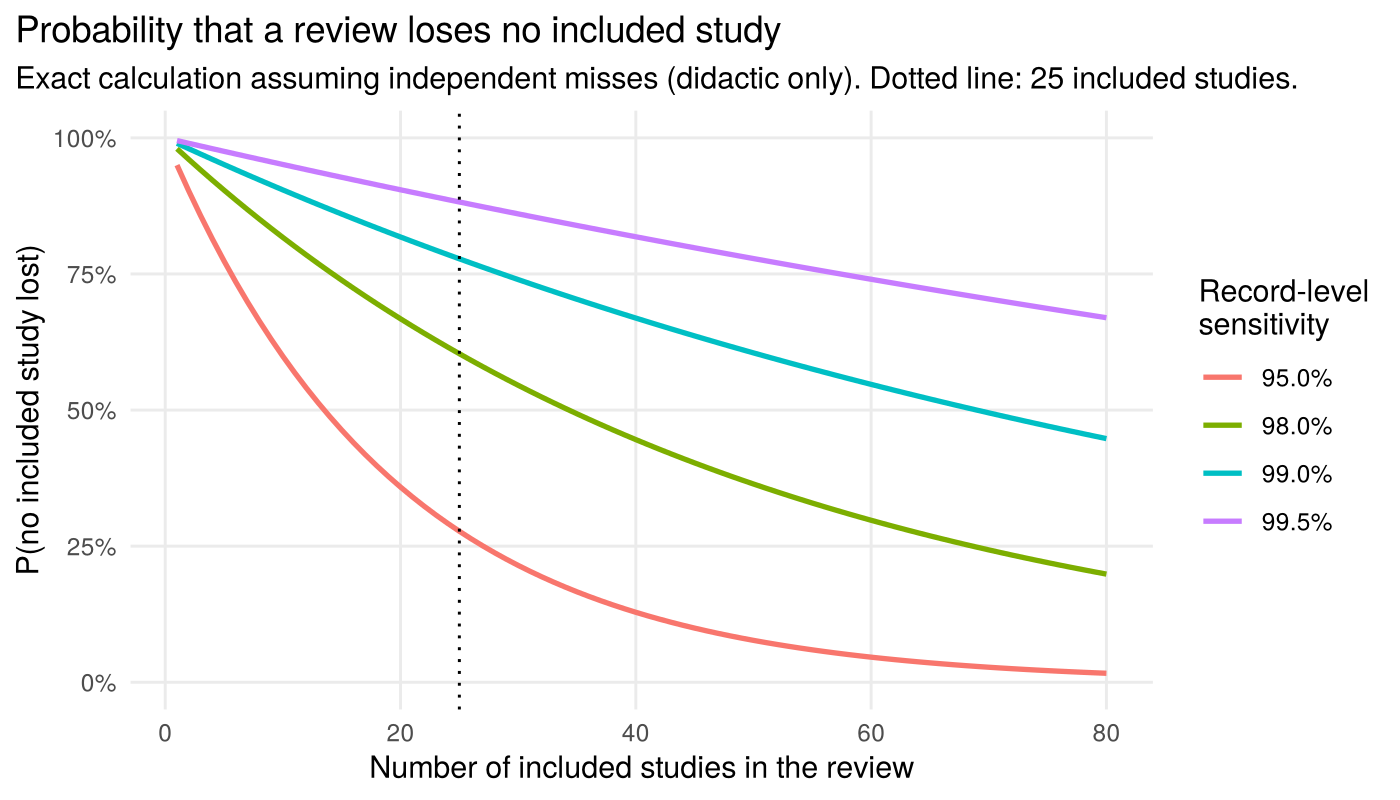
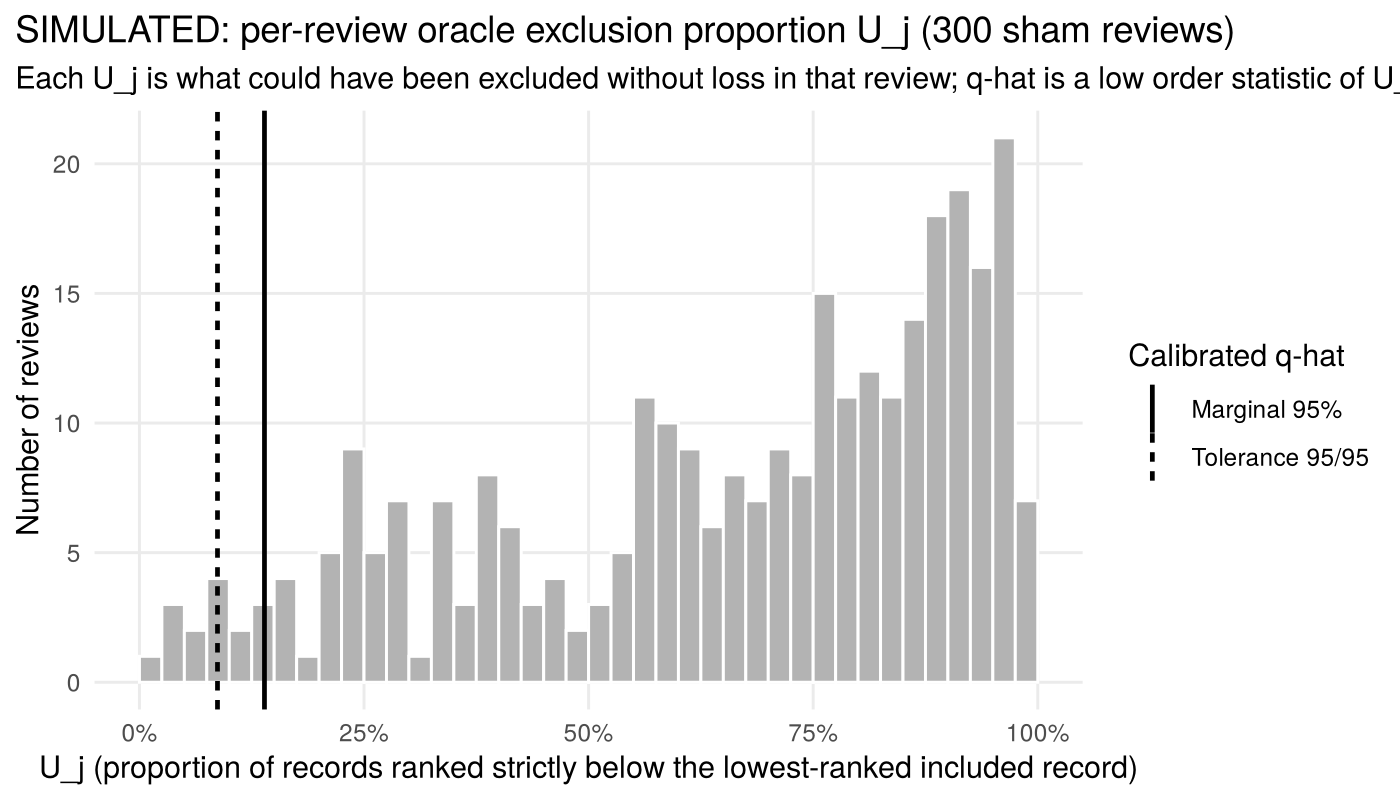
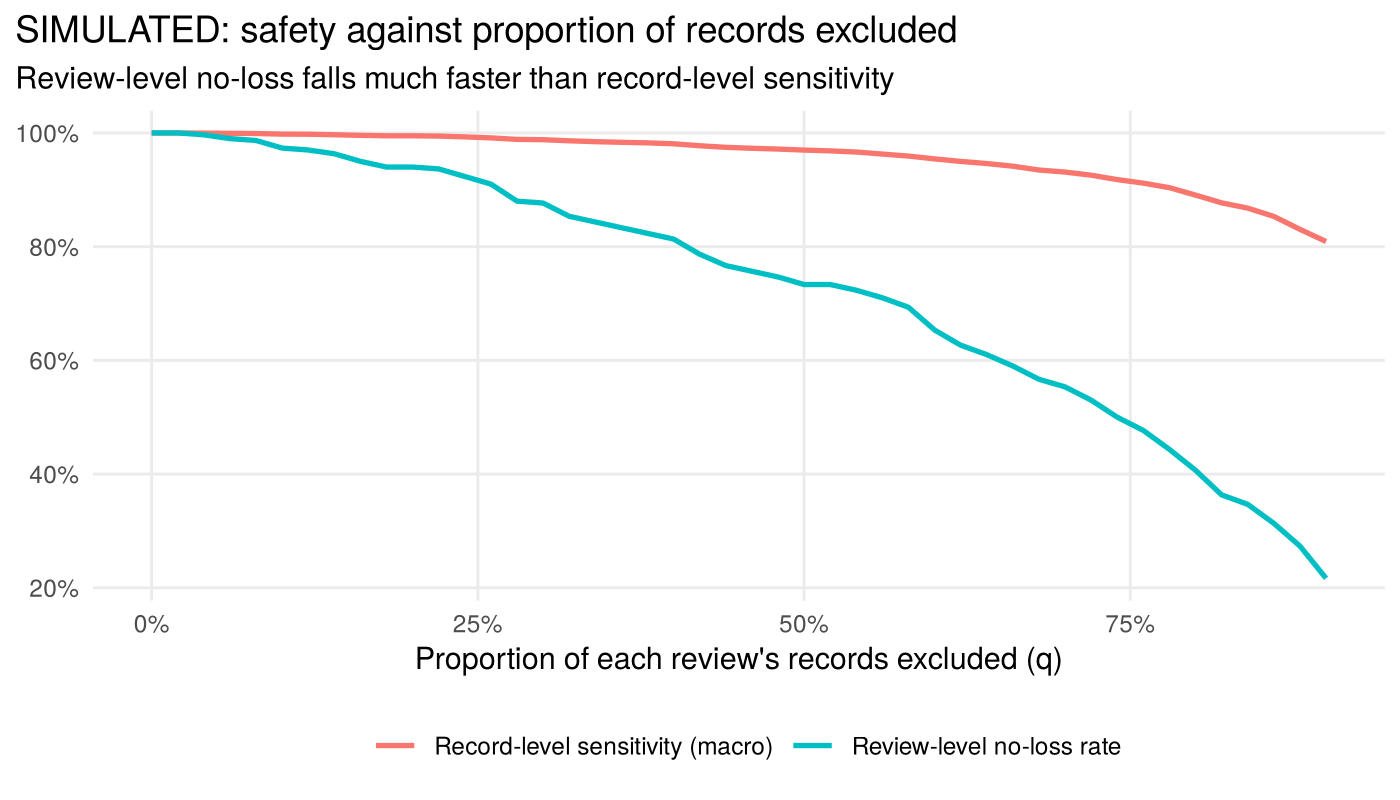
Record-level sensitivity is not review-level safety. If misses were independent, a review with 25 included studies would lose none with probability 0.9525 ≈ 28% at 95% sensitivity, 60% at 98%, 78% at 99% and 88% at 99.5% (Figure 1). Misses are not independent (some reviews are hard for a model), so review-level safety must be estimated empirically, which is what q* does. Figures 3 and 4 show, on simulated data, how q̂ is read off the distribution of Uj and how review-level no-loss falls much faster than record-level sensitivity as more records are excluded.
Zero observed misses do not prove a zero miss rate. With no misses observed, claiming sensitivity ≥ 95%, 98% or 99% with 95% confidence requires at least 59, 149 or 299 included records; with 99% confidence, 90, 228 or 459 [31]. “Zero false negatives” is therefore not an estimable objective; the defensible objective is a prespecified loss bound with stated confidence.
Figure 1: Hypothetical: probability that a review loses no included study if misses were independent. Exact calculation; didactic only.
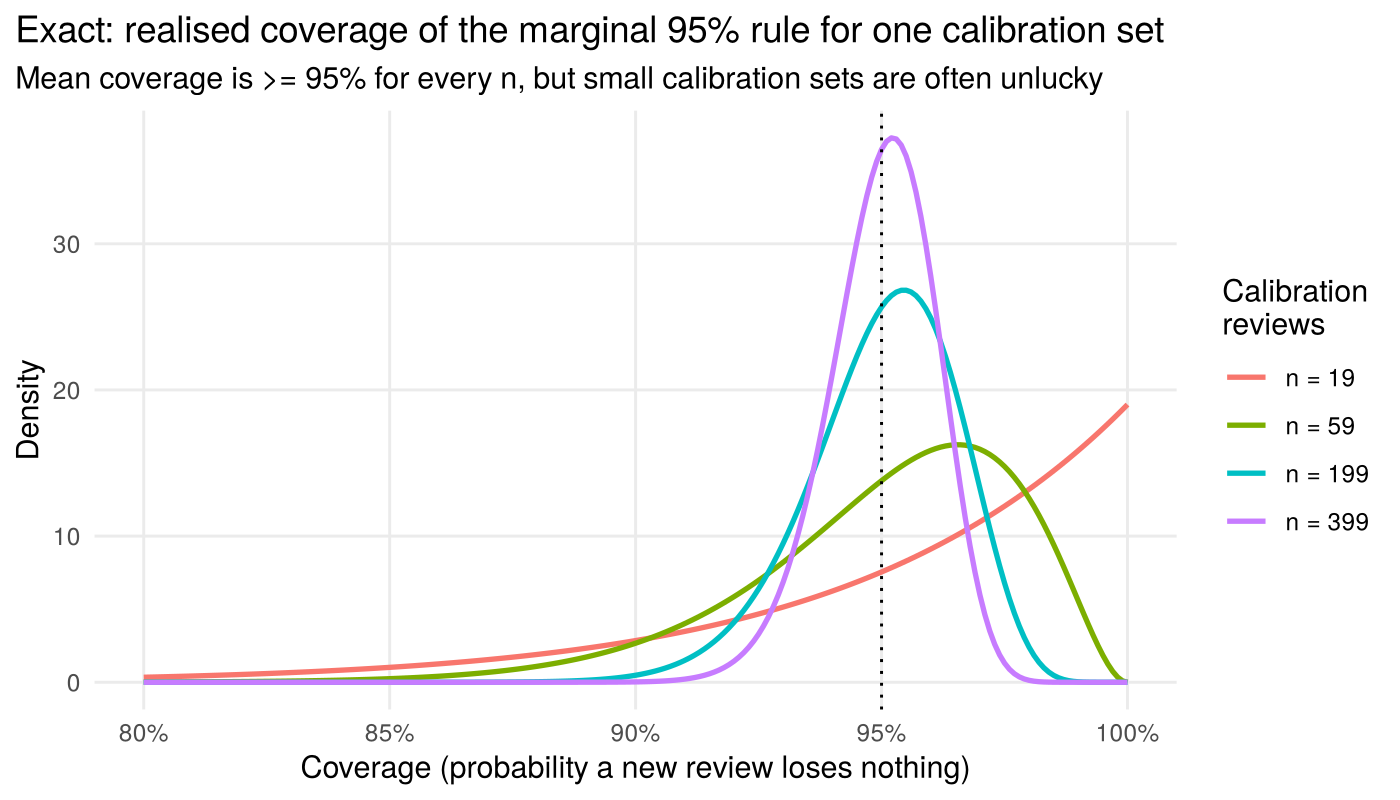
Figure 2: Exact: realised coverage of the marginal 95% rule for one calibration set. The density is Beta(n − k + 1, k) with k = ⌊0.05(n + 1)⌋.
Figure 3: Simulated (sham) data: distribution of Uj and calibrated cut-offs. Illustrates the method only.
Figure 4: Simulated (sham) data: safety against proportion of records excluded.
Spectrum effects (exploratory)
Sensitivity and Uj may vary with review characteristics rather than being constant.
We will examine their association with the number of included studies, the number of retrieved records, prevalence (nj/Nj), publication year and broad topic, using regression of logit(Uj) (with a small offset for 0 and 1) and of review-level no-loss, with cluster-robust or bootstrap uncertainty.
[OPEN: Sadegh: make sure the horse shit you wrote above is actually correct.]
Model comparisons and combinations (exploratory)
All models screen the same records, so comparisons are paired.
q̂: paired difference with a paired cluster bootstrap over calibration reviews (paired_q_diff_boot()).
Review-level no-loss at a fixed q: McNemar’s test for paired proportions [32].
Combinations: Any combination is a new score, so the same Uj and q* apply. To make models comparable, each model’s scores will be first converted to within-review percentile ranks. Prespecified combinations: (i) mean of percentile ranks; (ii) “retain if any model retains” (maximum percentile rank); (iii) a stacked score fitted on calibration reviews only. Any further combination is selected on calibration reviews and reported on verification reviews.
Sensitivity analyses
Excluding reviews whose search date was approximated by the “received date”.
Tighter and looser drift tolerance τ.
Restricting to reviews published after each model’s stated knowledge cut-off, if enough such reviews exist (expected to be few; see Limitations). [OPEN: Sadegh: hyperlink]
Sample size
Several planning quantities, namely the distribution of Uj near its lower tail, the yield of analysable reviews, the mean number of included studies per review (m̄) and the within-review correlation of misses (ρ), can only be estimated from a pilot in which models are actually run.
The models, prompts and settings are not yet fixed, so such a pilot is not possible at the time of writing.
We therefore do not report a pilot-based minimum sample size.
Instead, we report the parts of the calculation that do not need a pilot, because they follow from order statistics alone, and we show that the planned dataset exceeds them by a wide margin.
Feasibility floor. A nonzero marginal rule needs n ≥ 19 calibration reviews (α = 0.05) or n ≥ 99 (α = 0.01).
Tolerance guarantee. 95/95 needs at least 59 calibration reviews (k = 1) and 181 for k = 5; 99/99 needs at least 459 (k = 1) and 1,157 for k = 5.
Strata. Each stratum of included studies is a separate calibration problem. If the smallest stratum holds a share pmin of reviews and a share pcal goes to calibration, the analysable set must contain at least nstratum / (pmin · pcal) reviews; for example, 99/99 with pmin = 0.2 and pcal = 0.5 needs about 4,590 analysable reviews.
Verification. About 200–400 held-out reviews give the precision shown above (lower bounds of 91.7%–95.2%).
Record-level sensitivity. Driven by the number of included records, inflated by the design effect; for example only (m̄ = 15, ρ = 0.05), 98% ± 1% needs about 1,280 included records (about 86 reviews).
Model comparison. For McNemar’s test (80% power, two-sided α = 0.05), detecting a 10-point difference with 20% discordance needs about 155 reviews; 5 points with 15% discordance, about 469.
The precision of q̂ itself depends on the density of U near its lower quantile and is unknown until models are run. Under an invented distribution U ~ Beta(1.6, 0.9) (illustrative only), the standard deviation of the marginal q̂ is about 0.055 at n = 59, 0.032 at n = 200 and 0.011 at n = 1,600. This simulation (93_protocol_sample-size.r) will be re-run with the observed distribution of U from the calibration data and reported.
Census of a large candidate pool.
Roughly 20,000 candidate reviews were drawn at random from about 120,000; this number reflects what our collaborators could feasibly extract, not a sample size calculation.
It is a pool of candidates, not the sample: the analytic set is what survives eligibility criteria (a)–(d).
Because the analysable set is expected to exceed the minimums above, including the stringent 99/99 stratified requirement, we will analyse all eligible reviews, unless it is proven that it will be computationally impossible.
A large pool also serves the resource objective: a dataset that other researchers can reuse.
Compute cost. At roughly 600 records per review and about 100 decisions per minute, one model needs about 4 days per 1,000 reviews and about 42 days per 10,000 reviews of continuous running (93_protocol_sample-size.r). If a subsample is needed, it will be a stratified random sample of reviews (same strata as the split), its size M will be set to meet item 3 above for the chosen guarantee, and the decision will be recorded before models are run. All reviews not analysed remain in the published dataset.
It is essential to note that larger samples narrow intervals but do not correct a non-representative frame, an imperfect reference standard or contamination of training data. These are addressed separately in the Limitations. [OPEN: Sadegh. hyperlink]
Data freezing, preregistration and deviations
The analytic dataset, the split and this analysis plan are frozen and archived (Git tag, file checksums, timestamped Manubot build, and a public registration before any model output is generated.
No interim look at model results is used to change the plan, and there is no unplanned stopping.
Any deviation from this protocol is reported with reason and expected impact in the final paper.
Random seeds for tie-breaking, splitting and bootstrapping will be fixed and reported in the final code.
Software
Analyses will done in R. Packages and their roles (not final): dplyr, tidyr, purrr (data handling); ggplot2 (figures, including the operating curve and flow diagram); base stats (qbeta, binom.test) for exact Clopper–Pearson bounds; boot or the custom review-level bootstrap (cluster bootstrap); pROC (partial AUC) [33]; glmmTMB (beta-binomial model with review random effect) [34] and lme4 (alternative mixed models).
The nproc package implements the Neyman–Pearson umbrella algorithm [13]; it is cited for its conceptual relation and is not required for the primary analysis, which needs only order statistics.
Package versions will be recorded with renv.
Discussion
Anticipated results and how they will be interpreted
The two quantities that decide whether a model is useful are the safe exclusion proportion (q*, verified on held-out reviews) and the review-level no-loss rate at that proportion. Record-level sensitivity is reported alongside but cannot by itself establish safety. We prespecify the interpretation of the main combinations so that the results are not over-read.
Scenario
Held-out no-loss (lower bound)
q*
Interpretation
A. Safe and useful
≥ 0.90
Large (e.g. ≥ 0.5)
The model can remove a large share of title/abstract screening with the stated assurance, within this frame. Supports prospective evaluation in live reviews, not immediate replacement of guidance.
B. Safe but marginal
≥ 0.90
Small (e.g. < 0.2)
The guarantee holds, but the workload saved may not pay for the model; the economic analysis decides. Typical when a few hard reviews dominate the lower tail of Uj.
C. High record-level sensitivity, poor review-level safety
< 0.90
Any
Misses are concentrated in some reviews (clustering). Record-level sensitivity alone would have been misleading; stratified q* will show which reviews are at risk.
D. Safe only in some strata
Varies
Varies by stratum
E.g. safe for reviews with few included studies but not for large reviews. Recommendations become stratum-specific.
E. Rank and score rules disagree
—
—
If the score-based rule excludes much more in some reviews and much less in others, the model’s certainty is poorly calibrated across reviews; a fixed proportion is then the more predictable rule.
F. Combinations beat single models
—
Higher for combinations
Disagreement between models carries information; a cascade or “retain if any retains” rule may be preferred despite higher cost.
G. Failed verification
< 0.90 while calibration looked adequate
—
Suggests non-exchangeability between calibration and verification sets (e.g. drift over time) or a coding error; will be investigated.
Whatever the result, the curated dataset of reproduced searches and included studies is a significant contribution in itself, because most published systematic reviews do not share record-level screening data.
Limitations
Training-data contamination. Pretrained models may have seen the published reviews or their included studies, which would inflate performance. We will record each model’s stated knowledge or training cut-off where known. However, the exact training data of most models are not disclosed, so contamination can be neither measured nor excluded, and a sensitivity analysis restricted to reviews published after the cut-off will probably contain too few reviews to be informative, because the models are recent. This is both a limitation and a constraint on the design. We recommend a replication restricted to reviews published well after the models’ release.
Imperfect reference standard. Final inclusion reflects the review authors’ decisions, which contain errors [2,3]. Agreement with an imperfect reference standard is not the same as correctness.
Single-database simplification. Only included studies retrievable in PubMed are evaluated; studies found through other databases or citation searching are ignored. Although improbable, if these differ systematically (for example, grey literature or non-English studies), sensitivity for them is unknown.
Reproducibility of searches. Reported search syntax and dates are sometimes incomplete or approximate (field tags, missing dates, unreported limits), and PubMed changes over time. The drift tolerance and the received-date approximation reduce but do not remove this error. A sensitivity analysis will be done to separate those systematic reviews that explicitly state their search date and those that we have to fall back to the received-date approximation.
Exchangeability is a property of the frame. The guarantee is marginal over reviews and assumes that a new review is exchangeable with the calibration reviews. While it could reasonably be assumed, it does not automatically hold within every specialty, for reviews outside the 2021–2026 window, for reviews not in the PMC Open Access Subset, or for reviews without “systematic review” in the title. Models may also treat reviews from different fields very differently.
Frame restrictions from the pipeline. The automated pre-screen (for example, requiring a “received date”, a mention of PubMed or MEDLINE, and at least 1,500 body words) shapes the population in ways that are hard to describe in clinical terms.
Records without abstracts are not screened by the models and must still be read by humans.
Model settings. Due to lack of resources, not all combinations of prompts, settings and quantization can be tested; results apply to the frozen configurations. Model versions behind provider interfaces can change without notice; version identifiers and access dates are recorded.
Offline evaluation. This is a retrospective accuracy study. It does not measure time saved, reviewer behavior, or the effect of a pre-filter on the human screeners who see an enriched set of records.
No human comparator. within the same reviews; comparisons with human performance rely on external estimates.
Declarations
Ethics
This study uses published, openly licensed articles and public bibliographic records and involves no human participants or personal data.
Registration
This protocol will be registered on [OPEN] before data freeze: [OPEN; registration DOI]. Protocol versions are built and timestamped with Manubot [35].
Data availability
The curated dataset (review identifiers, extracted PubMed searches, re-run PMIDs, included-study mappings and, after the study, model outputs) will be deposited in [repository, e.g. Zenodo] under CC BY 4.0 at [DOI]. [OPEN]
As all included studies come from PMC Open Access Subset, which contains articles under different Creative Commons licences, their Introduction and Methods sections will be included in our data.
Code availability
All code is available at [https://github.com/alireza5969/dmsr-data] under CC BY 4.0, including the protocol analysis functions (R/90_protocol_functions.r to R/93_protocol_sample-size.r). An archived release will be cited by DOI.
Funding
This research received no specific grant from any funding agency in the public, commercial, or not-for-profit sectors.
Kimia Falamarzi — Validation, Investigation, Resources, Data curation, Writing — original draft, Writing — review & editing.
Fatemeh Zamani Marandi — Validation, Investigation, Resources, Data curation, Writing — original draft, Writing — review & editing.
Mohammad Amin Shahlaee — Validation, Investigation, Resources, Data curation, Writing — original draft, Writing — review & editing.
Ali Jamshidi Kerachi — Validation, Investigation, Resources, Data curation, Writing — original draft, Writing — review & editing.
Use of AI tools
AI was used in the following steps:
Some functions in the R code were written by AI These functions were only used on simple input/output values. They were not essential to the study’s logic. All these functions were reviewed by the first author to ensure correctness. The majority of the code was not written by AI.
Authors used AI in the revision process The manuscript draft was written without the help of AI. However, during revisions, authors used comments by AI. Those comments were only applied to the manuscript after verification.
Analysis AI was used to fact-check statistical decisions. The decisions were not done by AI.
Translation to Esperanto AI was used to translate the manuscript from English to Esperanto to be published alongside each other. The accuracy of translation was rechecked by the first author.
AI was not used in the logic of the study. Study was conceptualized and designed by human investigators.
Acknowledgements
We thank Filip Polak, developer of the Annotator browser extension, for responding quickly to our questions and for adding features we requested. These changes made Annotator well suited to the large-scale data extraction in this study.
References
1.
Analysis of the time and workers needed to conduct systematic reviews of medical interventions using data from the PROSPERO registry
Rohit Borah, Andrew W Brown, Patrice L Capers, Kathryn A Kaiser
STARD 2015: an updated list of essential items for reporting diagnostic accuracy studies
Patrick M Bossuyt, Johannes B Reitsma, David E Bruns, Constantine A Gatsonis, Paul P Glasziou, Les Irwig, Jeroen G Lijmer, David Moher, Drummond Rennie, Henrica CW de Vet, … Jérémie F Cohen
TRIPOD+AI statement: updated guidance for reporting clinical prediction models that use regression or machine learning methods
Gary S Collins, Karel GM Moons, Paula Dhiman, Richard D Riley, Andrew L Beam, Ben Van Calster, Marzyeh Ghassemi, Xiaoxuan Liu, Johannes B Reitsma, Maarten van Smeden, … Patricia Logullo
Consolidated Health Economic Evaluation Reporting Standards 2022 (CHEERS 2022) statement: updated reporting guidance for health economic evaluations
Don Husereau, Michael Drummond, Federico Augustovski, Esther de Bekker-Grob, Andrew H Briggs, Chris Carswell, Lisa Caulley, Nathorn Chaiyakunapruk, Dan Greenberg, Elizabeth Loder, … Sophie Staniszewska
The PRISMA 2020 statement: an updated guideline for reporting systematic reviews
Matthew J Page, Joanne E McKenzie, Patrick M Bossuyt, Isabelle Boutron, Tammy C Hoffmann, Cynthia D Mulrow, Larissa Shamseer, Jennifer M Tetzlaff, Elie A Akl, Sue E Brennan, … David Moher
PRISMA-S: an extension to the PRISMA Statement for Reporting Literature Searches in Systematic Reviews
Melissa L Rethlefsen, Shona Kirtley, Siw Waffenschmidt, Ana Patricia Ayala, David Moher, Matthew J Page, Jonathan B Koffel, Heather Blunt, Tara Brigham, … Sarah Young
NIH NLM NCBI PubMed Central (PMC) Article Datasets - Full-Text Biomedical and Life Sciences Journal Articles on AWS - Registry of Open Data on AWShttps://registry.opendata.aws/ncbi-pmc/
glmmTMB Balances Speed and Flexibility Among Packages for Zero-inflated Generalized Linear Mixed Modeling
Mollie Brooks E., Kasper Kristensen, Koen Benthem J.,van, Arni Magnusson, Casper Berg W., Anders Nielsen, Hans Skaug J., Martin Mächler, Benjamin Bolker M.
 0000-0002-7950-3270
·
 alireza5969